Friday, 27 October 2017

It's absurd but are we meant to laugh?

Jenny finds it hard to enjoy The Death of Stalin

Is it a satire? Yes. Is it reasonably true to the real events? Apparently. Is it hilariously funny, like Iannucci’s previous offerings such as The Thick of It or Veep? Not really.

It’s 1953 and Stalin (Adrian McCloughlin) has had a stroke. He is alone. Although they hear him fall, his guards are too terrified to enter his room and when they do he is in a coma. His underlings are summoned and begin to manoeuvre, panic and bicker about who will succeed him. But meantime they have to haul him on to a bed, a task they find fussily distasteful since he is a heavy man, reeking of urine, and they are still uncertain whether he will live or die. They would send for medical help but unfortunately all the decent doctors have been killed or dispatched to the gulag, so a posse of trembling young and old fools is assembled in white coats only to pronounce that he cannot recover. And he cannot.

Simon Russell Beale is perfectly cast as the sinister Beria, head of the secret police; Steve Buscemi is the slyly scheming Kruschev and the wonderful Jeffrey Tambor plays Malenkov, Stalin’s fluttering deputy, with more than a touch of Maura, his transgender role in Transparent. The accents are an unapologetic jumble of New York, Californian, posh English, estuary English and Yorkshire. Thankfully, no one does fake Russian.

Iannucci is a specialist in puncturing the pretensions of petty men, fatuous tyrants who have squirmed, lied and terrorized their way into power. He skewers their frustrations as the world - objects, people and events - unaccountably fails to bend to their every whim despite their threats and their investment in spin and fake news. The comedy of his TV series, The Thick of It, arises from the surreal profanity of their language, their grandiosity, their outrageous bullying and the way the onscreen drama seems so often to predict real events. For instance, in the spin off film of the series, In The Loop, Tom Hollander plays a character who confesses to a liking for pornography. Shortly afterwards the real life British Home Secretary was discovered to have added the cost of a pornographic movie to her parliamentary expenses.  

There are some good sight gags. Tambor plays Malenkov as preening and dim-witted.  A string trails from the back of his ill- fitting but no doubt expensive jacket and this turns out to be attached to a corset. Jason Isaacs plays Zhukov, the swaggering head of the army, with an ostentatious facial scar and so many medals pinned to his already garish uniform that he clanks as he walks.

Related image

Unlike the japes imagined with such zest in Iannucci’s previous work, the action of this film is apparently closely based on history. All this chaos, paralysis and bizarre politicking actually happened in the wake of Stalin’s death. But Stalin’s regime was not funny. People really were murdered on a whim and in their millions. Political enemies really were disappeared. Beria really did rape and torture.

The excellent ensemble cast must have enjoyed making this film. Their exuberance shows. But truly it is more like tragedy masquerading as comedy. Its tone and purpose seem uncertain. We watch the contemptuous open air cremation of Beria’s body and Stalin’s autopsy is shown in gruesome detail. On the first day of the film’s release, almost every seat in the cinema was taken. It’s safe to assume that most of us thought we would see something laugh-out-loud funny. But I heard no yelps of laughter, just a few grunts from time to time. The film was mostly watched in silence. Perhaps the election of another vain and stupid man to the pinnacle of power in the US makes it harder to laugh at lunatic tyranny. Perhaps that’s why as the lights went up we filed out silently, with sober faces.

Monday, 16 October 2017

Don't miss this party

Jenny gives Sally Potter’s political farce 5 stars

The Party is a terrifically enjoyable film. It’s a chamber piece made in pin-sharp black and white, only 71 minutes long and is very very funny.

It opens with a close-up of a brass lion’s head door knocker. Behind it is Janet (Kristin Scott Thomas) eyes wild with emotion, brandishing a gun. It’s a flash forward; everything else in the film happens in real time.

Cut to Janet in her elegant kitchen in one of those tall thin North London houses with a cramped, sunless garden. Janet is a senior politician. The event is to celebrate the news that she is to become the Shadow Minister of Health for her Party and all her close friends are invited. She is giggling exuberantly, nursing her phone in her chin as she prepares the vol-au-vents. Immediately we are into surprises because Janet is obviously talking to a secret lover. Janet is also maybe channelling Margaret Thatcher and showing off a little with her pinny and housewifey insistence on doing the catering herself. Personally I thought vol-au-vents a little too obviously retro for a smart party involving the post Referendum London middle class in 2017, but that’s just a quibble. 


Meanwhile in the heavily book-lined sitting room her husband, Bill, (a gaunt Timothy Spall) a man who sacrificed his career for hers, sits motionless in what looks like a catatonic state. What’s happening to him? ‘I’m Bill’ he says lugubriously, ‘Or I think I used to be’.

Image result
The guests arrive. They include April (Patricia Clarkson) and her boyfriend Gottfried (Bruno Ganz). Bruno is not reprising his brilliant role as Hitler in Downfall as here Gottfried is some kind of life coach with a new agey cliché for every situation, though maybe there is a sly joke within a joke here when April says, ‘Tickle an aromatherapist and you find a fascist’. April has a smart put down for everyone, but it’s a put down of the stiletto type which you don’t feel until it has slid in because it starts as a compliment, such as her comment to Janet, ‘I’m so pleased about your success – but you really must do something about your hair…’ Then there is the bickering lesbian couple (Emily Mortimer and Helen Cherry) whose shock is that IVF has been successful and that they are expecting triplets. Not just triplets but, oh dear, boys.

Everyone has secrets, including Tom (Cillian Murphy), a banker, who arrives distraught, sweaty, in need of another line or two of cocaine – and with that gun. Everyone also has life-changing announcements. Infidelity, illness, pregnancy, the compromising of publically held political principles, the post-Brexit confusion, betrayal: it’s all here.

I loved this film not least for its homage to so many predecessors. It could be a one-act early Simon Gray or Tom Stoppard play. It could be Mike Leigh when he still had a sense of humour: there is more than a nod to Abigail’s Party with its absent but critical character, in this case Marianne, Tom’s wife. There is also superb use of a MacGuffin, the term popularised by Alfred Hitchcock to describe an object or an idea with which the characters become obsessed but whose only real point is to drive the plot forward.

The stellar cast must have had enormous fun making this movie. They are all wonderful but if I had to choose I would say that Patrician Clarkson - haughty blonde mane, dramatic lipstick, exquisite timing - wins it for me.

This film is satire, written as well as directed by Sally Potter, and it is sophisticated farce. I watched it in the BFI’s excellent pop up cinema on the Victoria Embankment during the London Film Festival. There is a final twist where the huge audience erupted with laughter and applause. We absolutely could not have guessed the ending. 

I have lived in one of those tall thin North London houses where the kitchen can never be on the right floor and where catering for a party was always a nightmare. I’m not surprised that the vol-au-vents got burnt and had to be thrown out. Really, darling, another time just get Deliveroo or UberEats, even if it’s not politically correct. No one will ever know.

Joe's footnote

Kristin Scott Thomas's performance as ex-convict Juliette Philippe in Claudel’s 2008 film I’ve Loved You So Long (Il y a longtemps que je t’aime) is superb. But she’s great whatever she’s in. I know some people consider Four Weddings and a Funeral to be the great onscreen love story of the 90s, but I could never believe that Charles, however shallow, would fall for the inadequately scripted Carrie, while KST's sharp-tongued, sardonic Fiona was pining for him. 

Tuesday, 6 June 2017

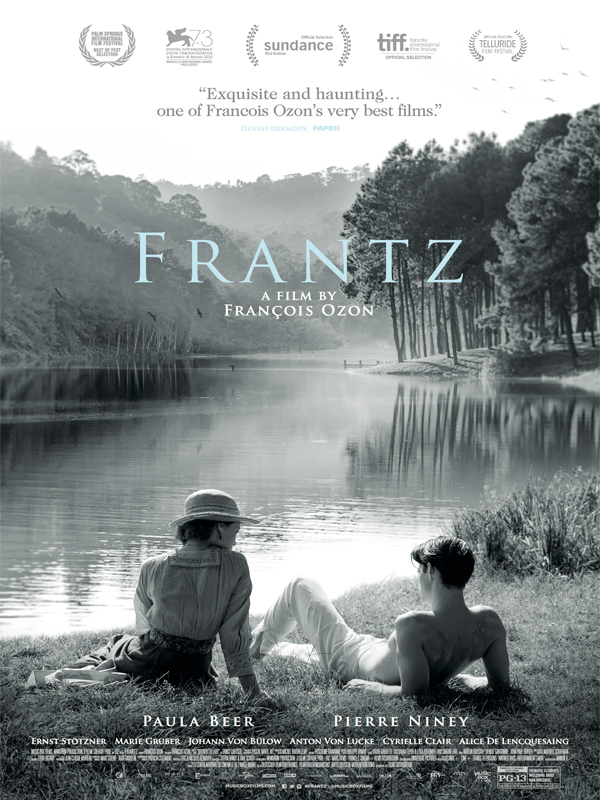
In Frantz it isn't only the hero's mustache that droops

One sniffy star is all Jenny thinks it's worth

My Persian cat is a fine sniffer-out of anything slightly ‘off’. He wrinkles his sweet but rather flat nose and I can see that a judgement is coming. My own nose was wrinkling as soon as Joe, my co-blogger pitched the idea of going to see François Ozon's Frantz. ‘This grieving German girl finds a strange young Frenchman standing at the grave of her dead soldier fiancé in 1919 and he gets to know her family.’ In a flash I correctly guessed two thirds of the allegedly Hitchcockian plot. I don’t like doing this. I don’t like watching bloopers, poor screenwriting and films that are too long because no one had the time to make them shorter. It destroys my willingness to believe that what I’m watching is not a film at all but something gripping and real.

Unfortunately there was so much of all of this in Frantz. First, it’s full of plot holes: how did Adrien (Pierre Niney), the French soldier track down the angry and bereft German family given the flimsy evidence he possessed? How did he know about Frantz’s pre war interests? Then there are all those little give-away details of a director too distracted to notice the give-away details: for instance, a supposedly full tureen of food is plonked on a table when the noise of the plonking shows clearly that it is empty. 

Then there is the scene where the hero impulsively swims in a lake, clad only in his longjohns; a stand-in might have done the swim with more elegant strokes instead of the undignified doggy paddle that we saw. After this, lounging sexily on the bank, his thick cotton underwear has seemingly dried out in seconds even though his body is still gleaming attractively with lake water. The whole scene would surely have been extremely unlikely in 1919. The extras have the awkward air of hastily recruited locals told to do a bit of walking up and down in the background. The editing seems perfunctory - so many unnecessary shots of people opening doors, coming in and out of rooms. At 20 minutes shorter it could have been a much better film.

Pierre Niney and Paula Beer in Frantz (2016)The actors do their best. Pierre Niney plays the French hero – his extraordinary nose and silly moustache deserved a credit all of their own. Paula Beer is elegant and more aristocratic than the part deserves as Anna, the bereaved fiancée.

But my real nose-twitching was about a director claiming to be an Auteur when maybe he is just a workaday storyteller. Can you make a serious film heavily freighted with symbolism and deep meaning if you are not driven by authentic passion for the subject? I don’t think so and I didn’t believe for a moment in the authentic passion. I saw a film where the director was in love with style, with his terribly sophisticated choice of colour-corrected black and white as the medium, with his cleverness in devising parallel scenes of nationalistic stupidity and prejudice, with little speeches about the futility of war. I didn’t want to see the train shots – on a journey, geddit? I was not gripped by the last two reels. These were some kind of low-energy detective story which seemed to belong in a different film. 

Slow, implausible, hastily stitched together. What’s to like?


Tuesday, 2 May 2017

Russian Gothic in the North of England

Jenny gives William Olroyd's Lady Macbeth five stars

No, it’s nothing to do with Shakespeare, just the title of a Russian story written by Nikolai Leskov in 1865 where the author wanted to find a suitable name for a woman who defies convention and carries through some increasingly terrible deeds.

Lady Macbeth (film).png
Katherine (Florence Pugh) is a teenage bride who has been part of a Buy One Get One Free deal between her impoverished family and the bullying mine owner who purchases her for his weak and dislikeable son. She is a virtual prisoner, forbidden to leave the house. So far, so familiar: we’ve seen the poor downtrodden girl before, we know what to expect from the wedding night, the windy walks on the moors with hair flying, and then the inevitable transgressive sex with the handsome dark-skinned groom (Cosmo Jarvis). Oh yes, we’ve seen Wuthering Heights. We know what happens to women like Madame Bovary and Becky Sharp. It’s almost enough to make you want to shout, ‘Don’t do it Katherine! Haven’t you read your Lady Chatterley?’

So the film is apparently a bodice ripper and bodices do get ripped. It’s set in the English North East so there are appropriately gritty accents. There’s period décor and costume. Many of the scenes are visually startling with one vivid colour, for instance Katherine’s bright turquoise dress, splashed into an otherwise monochrome frame.

But what’s this? The heroine wears a crinoline cage and is laced hard into corsets but she also wears Boots Number 7 eyeliner. There is an orange pet cat as restless as she, and it’s a Cornish Rex, a breed not invented until 1950. She gets drunk in a thoroughly 21st century teenager-y way, combining smirking insolence with a little light falling over. She eats like every modern teenager I know – that is to say by holding her cutlery in an extremely peculiar way. The film was shot on location at Lambton Castle in Wearside and I could swear that the paint is straight out of the Farrow and Ball catalogue, in fact it looks very like Mouse’s Back, the same exquisitely tasteful colour that our ex-prime minister has chosen for the quaint little old-but-new ‘shepherd’s hut’ where he will be pretending to write his memoirs.

Image result for Vilhelm HammershøiWilliam Oldroyd has spoken of getting inspiration from the Danish artist Vilhelm Hammershøi, who has often painted women facing away from the viewer, sometimes looking out of a window in an isolated landscape. The effect in the film (the production designer is Jacqueline Abrahams) is of empty stone stairways and tall rooms which have had all the air sucked out of them.

There are black and mixed race servants though no one makes the slightest comment on this; there is class prejudice and sexism; there is cruelty; there is sex; there is crime. But the director has not wasted what he learnt in his earlier career in opera where themes of Grand Guignol revenge can mix readily enough with farce. The moral corruption of the characters emerges gradually as you begin to realize that the plot displays all the conventions only to promptly upend them. This is no simpering heroine, but you will have to see the film to discover how and why. The director has borrowed from Haneke, Hardy, Andrea Arnold and most notably from Scandi Noir but has created a style that seems unique, fresh and possibly a little reckless. 

The screenplay, written by Alice Birch, has minimal dialogue and indeed one of the characters becomes mute during the course of the action. The cast are magnificent. There is almost no music. The sound designer, Ben Baird, deserves every possible award for the way he evokes the unsettling voice of the house: the austere squeak of shutters being opened, the clatter of feet on wooden floors, the scrape of knives on plates and the echo of words spoken in rooms stripped of comfort. Most amazingly of all, the film was shot in 24 days and made for under £500,000. This is the film equivalent of a fiver. Well done you guys, I look forward eagerly to your next project.


Tuesday, 25 April 2017

There are great films about ageing but this isn't one

Jenny is underwhelmed by The Sense of an Ending

Julian Barnes’ very short book left me underwhelmed in 2011, wondering why it had won the Booker prize, and Ritesh Batra's film of the book has left me even more so. What happens? Nothing much, though the little that does happen seems intended to be have tremendous meaning.

Image resultTony Webster (Jim Broadbent) is a prosperous ageing man who potters about repairing and selling vintage cameras. He has been a bystander in his own life where his short temper, charmless indifference to others and lack of emotional intelligence have probably lost him his marriage. His only daughter is about to give birth and he also risks losing connection with her. Then he gets a letter which sets him on a quest – to do what exactly? Discover himself? Find out what he has resolutely ignored for so many years? Get redemption? His former girlfriend Veronica (Charlotte Rampling, whose stare could freeze a thousand ex boyfriends) and his former wife (Harriet Walter) do their best to treat him with the impatience he deserves.

The film’s attempts at a final twist are undermined by its conformity to the late film critic Roger Ebert’s Rule of Economy of Characters. This is the one where an underdeveloped character who seems extraneous to the plot turns out to be essential to it, so any experienced movie-goer will guess the drifty non-ending long before it happens.

I don’t think we do films about ageing at all well in the UK. The films pass the time pleasantly enough and are then instantly forgettable. For instance, there’s cute-and-quirky (Best Marigold Hotel), embarrassing (Venus: Peter O’Toole getting over-personal with a young woman) sentimental (Quartet: old thesps do their thing), suppressed melodrama (45 Years) or just dull (Another Year).  Where casting is concerned, there seems to be a serious lack of imagination. The same small group of actors comes round again and again:

‘Shall we cast Bill this time so that he can do his full Nighy, or maybe give Tom W another go?’
‘Nah, let’s stick to good old Jim.’

Jim Broadbent does his best with the leading part here, though somehow he seems too twinkly and whimsical to be convincing as the curmudgeonly Tony. Now that a few days have passed, I find it hard to remember how this performance was all that different from what he did as Nick in Le Weekend, John in Iris, Father Flood in Brooklyn or Tom in Another Year.

It is possible to make enthralling films about older people without patronizing or stereotyping. Alexander Payne has done it at least twice with About Schmidt and Nebraska. Both these films also feature disastrously unaware and unlikeable ageing men and have you squirming with pity, fervently hoping that you don’t recognise yourself in their dilemmas - and smiling. Clint Eastwood did it in his gripping Gran Torino. Michael Haneke brought his merciless eye to Amour. Nor does such a film have to be either grim or sentimental: Iñárritu’s Birdman (Michael Keaton plays an ageing actor who is desperate to reprise his fame as a superhero) was to me one of the funniest films of 2014. 

The film industry has grasped that there are large numbers of baby-boomers who like cinema and who might enjoy seeing their own age group on screen. But producers need to do better than The Sense of an Ending. No one in the sparsely populated Islington Vue audience seemed to be under sixty but we all filed out silently with what looked to me like pretty doleful faces.


and Joe remembers the Booker Prize gossip  

I haven’t seen the film and can’t remember much about the book. But I do remember the apparent randomness of the Man Booker Prize judging process the year it won. First the short list put the cat among the pigeons by dissing a bunch of recognised heavyweight authors, who had published that year, in favour of unknowns and novices. Of the six authors on the list, only Julian Barnes had a track record.

This seemed bold and refreshing until the chair, a retired spy, and another of the judges, an MP, expressed their preferences for “readable” books that “zipped along” – arbitrary criteria, surely, for a literary prize. Cue howls of protest from those who felt that zippy readable books were already sufficiently rewarded by profitable book sales. 

Two separate kinds of objection – the principled one that the winner should be a book of serious literary merit, and the personal one that Marty, let’s say, or Ian or Salman shouldn’t be pushed out by some writer we’d never heard of – inevitably got muddled in the press reports. When the judges finally settled on The Sense of an Ending, a relatively insubstantial book, it felt, rightly or wrongly, as though the judges had been cowed by the old boys’ club. 


Sunday, 9 April 2017

Skewering the illusion of post-racial America

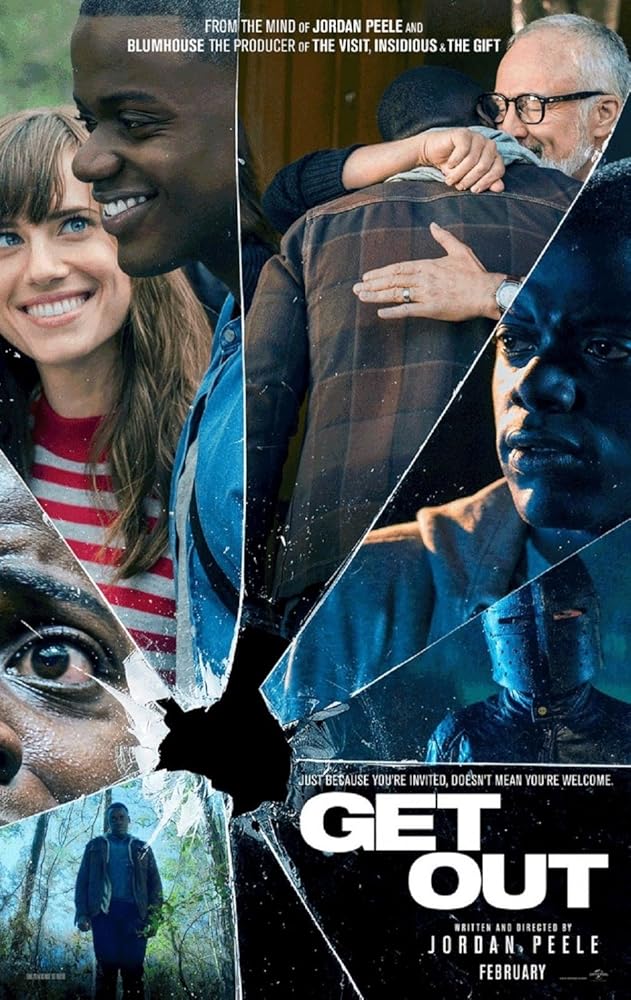
Jenny gives Jordan Peele's new film Get Out an enthusiastic 4 stars

A British doctor friend recounts the following frequent piece of dialogue when people meet him for the first time:
So where are you from?
Croydon, says Matthew
Yes but where are you from?
If he wants to tease them, he can keep this going for some time, knowing that the real question is, ‘You’ve got a brown skin, you sound middle class English but you look Asian so are you from Pakistan or India?’ The truth is that he really is ‘from’ Croydon, has never been to South Asia and the grandparents who came penniless to the UK from India via Uganda in the upheavals of the 1970s are long dead.

Image resultThis is the kind of unaware patronizing chat that the first half of Get Out explores with a uniquely sardonic eye. Chris, a successful photographer played superbly by the British actor Daniel Kaluuya, is on a meet-the-parents weekend with his girlfriend Rose (Allison Williams). ‘Do they know I’m black?’ he asks anxiously. ‘Oh no’, she says, telling him that her parents are so unracist that they would have voted for Obama for a third time, had that been possible. This trying terribly hard to show how colour blind you are is squirmily funny and maintained throughout a grisly party where the affluent and somewhat time-worn guests make graciously condescending references to Tiger Woods or, more gratingly, ask coy questions about the supposed sexual prowess of black men.

It is a long time since I have seen a film which so recklessly and confidently mashes up styles and genres. It is biting social satire, it is comedy – with a great turn from Lil Rey Howery as Chris’s best friend and dog-sitter. Then it becomes horror straight out of Rosemary’s Baby and The Stepford Wives though possibly not anything like shocking enough for the experienced horror movie-goer because there is always a lurking edge of hysterical laughter even in the most violent scenes.

What is not funny is the way the film reveals the crevasse of trauma that exists in race relations in the US. The wariness about crossing the racial divide in romantic relationships, the cultural appropriation, the lurking expectation of rejection, the impossibility on both sides of forgetting the shame of slavery – it’s all there.

Could such a film be made here? Probably not: the target is far too elusive where race is concerned. London is increasingly a city where a mixed racial heritage is barely worth anyone mentioning or even noticing. But underlying attitudes to cultural differences are alive and well. We just have our own specially British versions with ‘jokes’ about Polish plumbers, Spanish waiters and German bossiness. Our resentment and fear is better hidden but it’s there all right.

What Get Out explores is peculiarly American. Jordan Peele, who has a white mother and an African American father, says that he wrote the film to point out the hypocrisy of assuming that present day American is ‘post racial’. The real theme of its clammy horror and sly humour is visible in the faux-modesty of the parents’ house with its antebellum portico and strangely zombie-like black servants who are so amazingly loyal that they cannot leave.

It is a stroke of genius to cast Bradley Whitford as Rose’s unctuous neurosurgeon father, when despite his many other acting credits, BW is surely associated most with his role in The West Wing as a self-assured, clever, fast talking member of the privileged liberal elite. We are bound to think, ‘Ah, so that’s what all those politically correct people in the fantasy-perfect White House were really thinking!’ The film seems to ask, with perfect timing, ‘What if the Obama years were just an illusion?’ Despite the laughs, the director’s answer is clear: it was a hoax and now we can see the ugliness in American society that was there all along.


Saturday, 8 April 2017

Joe's shorts 2: Whose homeland?

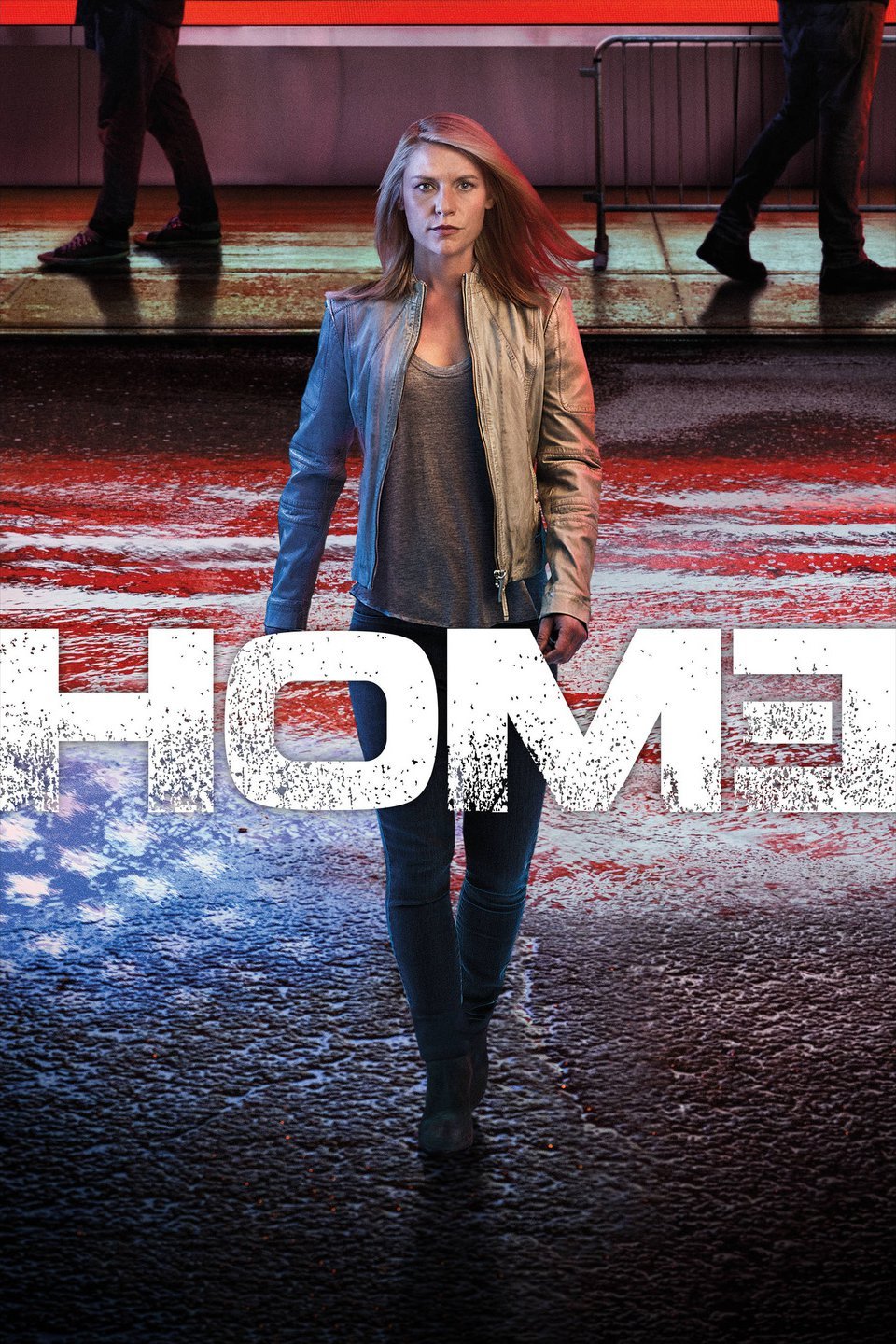
What I’m thinking about Homeland in 200 words

Image resultWhen the Showtime series was pranked in 2015 by artists who, asked to decorate the set with Arabic graffiti, sprayed satirical slogans about its racism, the show was busted on three levels. (1) It had all been about decent white Americans hunting nasty backward Muslims, the cost of freedom being Carrie’s manic vigilance. (2) Scary images of Arab backstreets and refugee camps were regularly served up as desolation porn to be enjoyed from the comfort of our Western couches. And (3) no one on the payroll spoke a word of Arabic.

Writers of series 6 seem to have been shamed into a re-think. Carrie, now no longer associated with the CIA, is reborn as a passionate advocate for Muslims wrongly suspected of terrorism. Her new pal, the President Elect, is like Clinton in being a trouser-suited female, but unlike Clinton in being so critical of America’s anti-Muslim wars abroad and police state tactics at home that the CIA are willing to commit homeland murders to destroy her. Meanwhile, with Carrie back on her meds, it’s up to the disabled CIA veteran Peter Quinn, now a prime CIA target, to keep us guessing whether his obsessive wild-eyed behaviour is paranoia or prescience.